OnePortfolio
Transforming Fragmented Enterprise Purchasing into One Cohesive Experience
Role: Design Lead
Direct Ownership: Multi-Account Sales Experience
Scope: 0-to-1 Enterprise Purchasing & Systems Design
Collaboration: Product, Engineering, Legal, Sales & Quote Buying Experience Design
My Role and Contribution
As Design Lead, I owned the end-to-end design of OnePortfolio's multi-account sales experience, from defining the initial product structure through detailed interaction design and engineering handoff.
My key contributions included:
0-to-1 Product Design: Designed a new sales experience for configuring and managing purchases across multiple accounts.
Cross-Functional Leadership: Collaborated with Product, Engineering, Legal, Sales, and the Quote Buying Experience design team to align workflows and requirements across the purchasing journey.
Systems Thinking: Partnered with Product and Engineering to define the Portfolio object and its relationships to accounts and purchasing transactions, establishing a foundation for future capabilities.
Cross-Functional Leadership: Collaborated with Product, Engineering, Legal, Sales, and the Quote Buying Experience design team to align workflows and requirements across the purchasing journey.
I partnered with a fellow designer who led the customer-facing purchasing experience, ensuring both experiences worked together as one cohesive solution.
01 — Discovery + define
02 — Exploring solutions
03 — Design + implementation
03 — Measure + reflection
Design process
01 — Discovery + define
Aligning on the problem, opportunity, scope and success criteria.
Understanding the problem
As HubSpot moved upmarket, large organizations increasingly wanted to purchase dozens—or even hundreds—of HubSpot accounts under a single commercial agreement. An account is an individual instance of the platform, with its own users, subscriptions, billing, and contract terms. Large organizations may operate multiple accounts across brands, business units, or regions.
Issue #1: 1 account = 1 purchase experience
HubSpot's purchasing infrastructure treated each account as a separate transaction. For an enterprise customer purchasing 50 accounts, this meant:
50 deals to manage
50 quotes to configure and approve
50 checkout flows to complete
50 contracts to execute
What should have been one enterprise purchase became 50 separate purchasing processes.
Issue #2: Manual workarounds weren’t scalable
Sales reps relied on manual spreadsheets to track accounts, quotes, approvals, and purchase statuses. To spare customers from completing dozens of checkouts, reps obtained legal approval to purchase on their behalf, shifting much of the manual work to Deal Desk.
The process could take weeks, creating significant operational overhead and limiting HubSpot's ability to scale enterprise sales.
The business opportunity
Simplifying multi-account purchasing could improve enterprise win rates and unlock larger deals.
HubSpot's Product and Finance teams identified:
8,500+ qualifying customers who currently own more than 1 account
$50M in projected ARR based on a 5% improvement in up market win rate
Defining scope and metrics
My team organized the initiative into milestones:
01- Sales Experience
Simplify multi-account portal quote configuration and sales workflows.
02 - Customer Buying Experience
Consolidate checkout and contract signing into a single purchasing experience.
03 - Account Management
Centralize account visibility, subscriptions, billing and payments.
(Shifting priorities: During Milestone 1, a separate upmarket initiative took priority, and Milestone 3 was deprioritized. We continued focusing on purchasing while ensuring the underlying design could support future account management capabilities.)
We established 3 dimensions of success
Business impact: Improve enterprise win rates and unlock larger deals.
Operational efficiency: Reduce manual work and time spent configuring, approving, and completing purchases.
Customer experience: Enable buyers to complete multi-account purchases through a single checkout and signing experience.
The initial pilot would help validate these outcomes and inform future improvements.
02 — Exploring solutions, evaluating feasibility and designing for scale.
With our priorities defined, I began delving into how we could support multi-account purchasing within HubSpot’s existing infrastructure.
My exploration focused on:
Industry standards: Reviewed how other enterprise platforms approached multi-account purchasing, billing, and account management.
Technical feasibility: Partnered with MAM Engineering to understand the proposed architecture, technical constraints, and implementation feasibility.
Early design exploration: Created initial low-fi concepts and workflows to evaluate approaches, gather feedback, and align Product and Engineering.
Defining the portfolio model
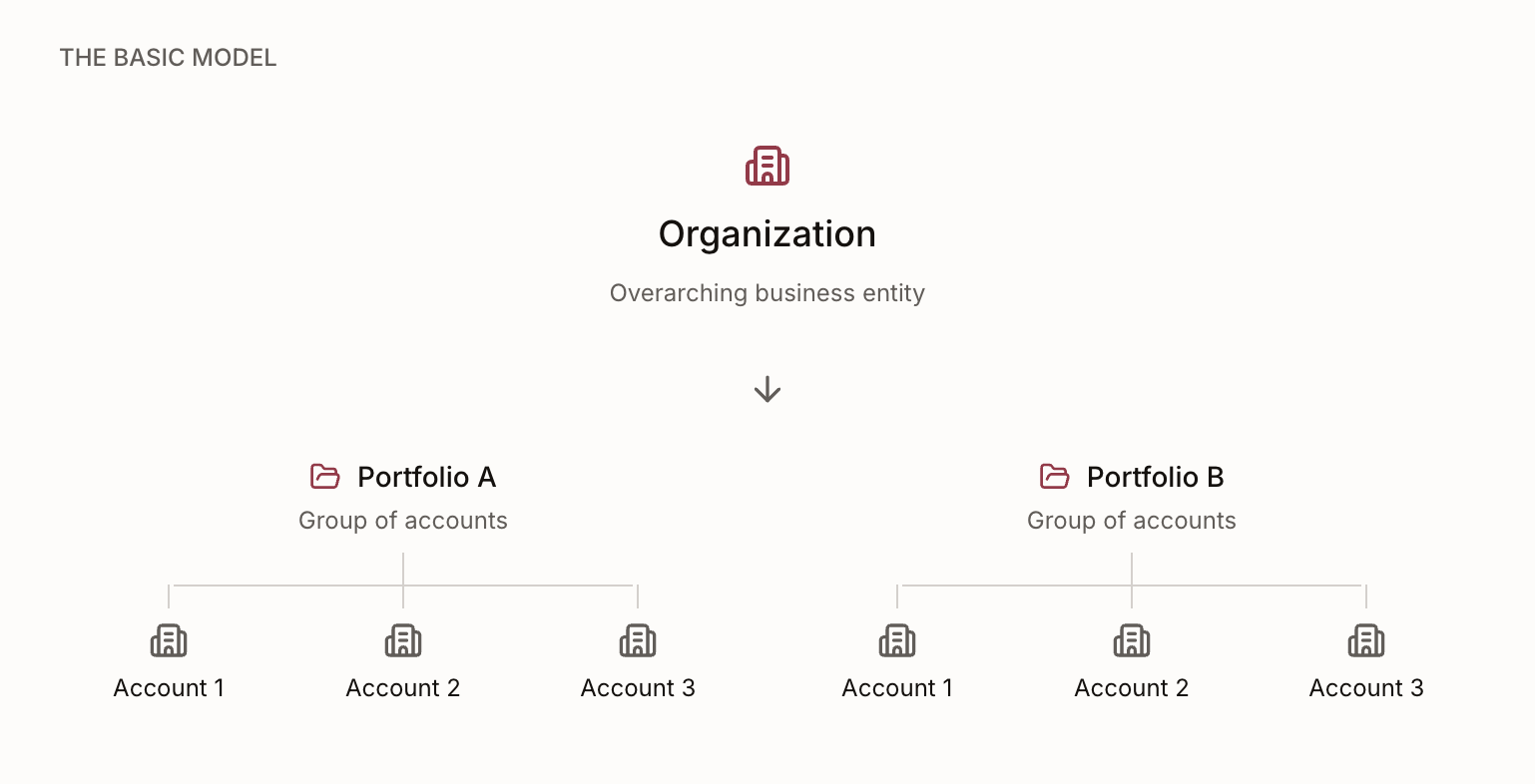
Our product team recognized that a single organization might need to purchase and manage different groups of accounts independently—for example, grouping North American and European accounts separately.
Our existing model lacked a way to organize subsets of accounts.
Working with Product and Engineering, we introduced the Portfolio: a persistent grouping of accounts within an organization.
We also considered how portfolios might support future purchases, renewals, and centralized account management, while keeping the initial scope focused on net-new sales.
Exploring the end-to-end sales workflow
I partnered with Sales to understand their existing manual process and identify opportunities to simplify and accelerate multi-account purchasing.
Working closely with Engineering, I aligned the experience with the required sequence of technical operations: account creation, deal creation, quote configuration, validation, billing customer creation, and consolidated order generation.
I also collaborated with the Quote Buying Experience designer to introduce a Combined Order Package that preserved individual account agreements while providing buyers with a consolidated, scannable summary of their purchase, simplifying contract review without changing the underlying agreement structure.
Designing around familiar workflows
Sales reps were already using Google Sheets to track accounts, quote configurations, approvals, and purchasing progress.
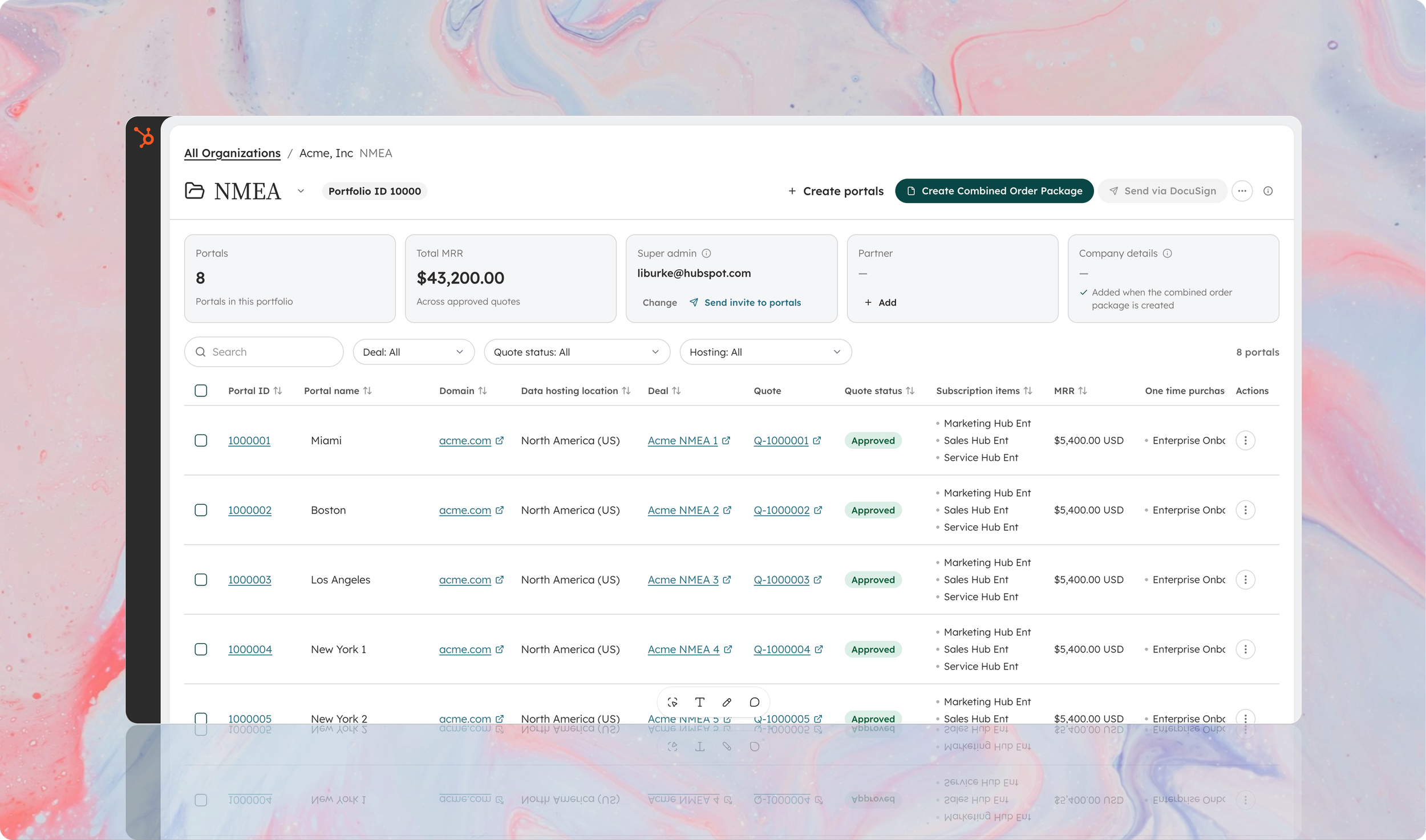
I explored a centralized, table-based Portfolio workspace integrated with HubSpot's existing account creation app, CRM and Quoting tools.
This approach preserved a familiar workflow while creating opportunities for bulk actions and centralized progress tracking.
03 — Design + implementation
Refining the solution, designing key interactions and supporting implementation
With the core workflows established, I translated early concepts into high-fidelity designs and prototypes.
I focused on simplifying complex multi-account workflows, refining interaction patterns, and ensuring consistency with HubSpot's existing CRM and Quoting experiences.
Key interactions:
Bulk account and deal creation
Value: Accelerating repetitive setup tasks - time saver
Designed workflows that allowed reps to create multiple accounts and generate associated deals in bulk, eliminating the need to repeat these steps individually.
Centralized portfolio workspace
Value: Visibility and control in one place
Utilized table component where reps could manage accounts, monitor quote configurations, track approvals, and identify purchase readiness without relying on external spreadsheets.
Click to enlarge and view UI annotations
Quote cloning
Value: Reducing repetitive configuration - time saver
Introduced the ability to “copy and apply” a quote configuration across accounts while allowing reps to customize individual quotes for account-specific requirements.
Consolidated order summary
Value: Making complex multi-account purchases easier to understand.
Partnered with the Quote Buying Experience designer to introduce a scannable order summary highlighting individual account agreements, total contract value, and initial payment. This artifact gives buyers a clear, scannable overview of their total financial commitment and key contract terms, eliminating the need to review each individual agreement in detail.
Click to enlarge UIs
Click to enlarge and view UI annotations
Engineering Collaboration & Handoff
Building alignment early to ensure a smooth implementation.
I held weekly design syncs with Engineering to review Figma prototypes, interaction patterns, and workflows, ensuring alignment well before handoff.
When development began, I provided annotated designs and high-fidelity interactive prototypes to communicate detailed behaviors, including loading states and validation interactions.
Throughout implementation, I remained closely involved, answering questions and refining designs as new edge cases emerged.
This collaborative approach helped minimize surprises and maintain alignment between design intent and implementation.
Preparing for launch
At the time of my departure, the experience was in implementation and QA, with the initial pilot still ahead.
While I wasn't involved in the final design fit and finish or post-launch measurement, I had completed the core designs, supported engineering handoff, and collaborated through implementation to address questions and emerging edge cases.
04 — Measure & reflect
Defining how success would be evaluated and reflecting on the experience.
Measuring success
Content currently being updated
Reflection
Content currently being updated