Waterfall Contracts
Enabling flexible, multi-phase enterprise contracts.
My Role and Contribution
As Design Lead, I owned the quoting experience, from how sales reps configured complex phased contracts to how enterprise customers reviewed and approved them.
Beyond my direct design work, I led procurement research, established shared UX requirements, and coordinated designers across multiple Fintech teams to deliver a cohesive experience spanning approvals, checkout, billing, and renewals.
I continued evolving the experience through subsequent milestones, supporting increasingly sophisticated contracting scenarios.
Role: Design Lead
Direct Ownership: Quote Config + Customer-Facing Quote
Scope: Enterprise Quoting & Contracting
Collaboration: Cross-functional Fintech teams
01 — Discovery & define
02 — Baseline comprehension testing
03 — Scaling design across the buying and billing ecosystem
04 — Supporting milestone 2
05 — Impact
Design process
01 — Discovery + define
Aligning on the problem, opportunity, success criteria and scope.
Understanding the problem
As HubSpot moved upmarket, enterprise customers increasingly needed to commit to software purchases upfront while gradually increasing adoption and spending over time.
However, HubSpot's existing contract model couldn't support multiple phases within a single agreement. Sales teams relied on two costly workarounds:
Heavy upfront discounting: Offering significant discounts on products customers weren't ready to use, reducing contract value and establishing lower pricing expectations.
Multiple future-dated contracts: Creating separate agreements for each phase, introducing additional procurement and approval cycles while making future commitments less certain.
These limitations created friction for enterprise buyers and made it harder for HubSpot to structure larger, more sophisticated deals.
The business opportunity
$21M in projected incremental ARR over three years
Enabling multi-phase contracts would help HubSpot win larger enterprise deals, reduce discounting, and secure long-term commitments.
The design challenge: Support more sophisticated purchasing requirements within HubSpot's existing quoting and contracting ecosystem, without adding unnecessary complexity for sales reps or buyers
Success criteria
My team’s initial goal was to pilot six net-new contracts, while developing the capabilities and *financial infrastructure required for broader adoption.
We aligned on three dimensions of success:
Product capabilities: Enable sales reps to create and execute contracts with phased commitments, delayed billing, and scheduled changes.
Business impact: Support larger enterprise commitments, improve deal conversion, and reduce reliance on discounting.
Operational efficiency: Reduce manual workarounds, repetitive approvals, and back-office processes.
*Financial infrastructure - Dependency for full rollout: Supporting phased commitments required significant changes to HubSpot's financial infrastructure. Revenue recognition development progressed in parallel, ultimately influencing the timeline for broader availability.
Scope: What we’re solving now vs. later
We aligned on what needed to be supported in the initial pilot and what could be introduced in future milestones.
Milestone 1 — Initial Pilot
Net-new contracts exceeding $6K MRR, supporting:
Multiple contract phases
Scaling quantities
Ascending discounts
Initial free periods
Contract term resets
Milestone 2 — Expanded Capabilities
Scaling products / services
Mid-term contract changes
Phased renewals
Upcoming phase notifications
Aligning Teams Around a Cohesive Experience
While I owned designs for Quote Config and the customer-facing Quote, Waterfall Contracts required coordinated changes across approvals, checkout, billing, and renewals - the entire assisted buying and billing experience.
I partnered with Product, Design, and Engineering to establish UX requirements, identify cross-product dependencies, and align teams on what each milestone needed to support.
My design priority was to ensure we weren't building isolated features, but a cohesive contracting experience that could evolve to support increasingly complex scenarios.
02 — Baseline comprehension testing
Early evidence established an informed design foundation
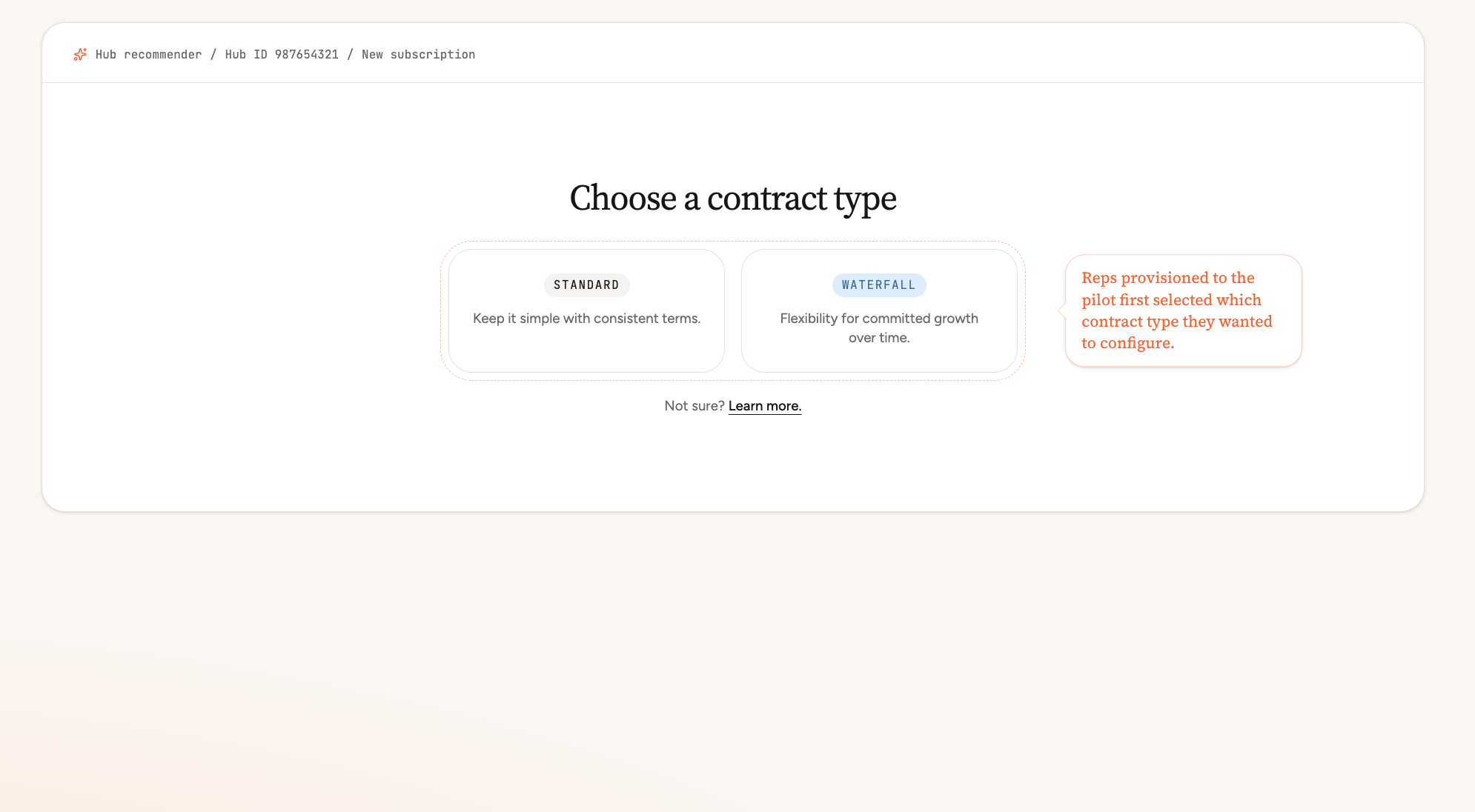
Starting with the customer-facing quote
I started by exploring how we could extend HubSpot’s existing Quote components to support multi-phase contracts with minimal changes.
Reusing existing patterns would reduce development effort and maintain consistency, but we needed to validate whether they could clearly communicate more complex financial commitments.
The key question: Could enterprise buyers easily understand what they were purchasing, when their commitments would change, and how much they would owe?
Evaluating Customer Comprehension
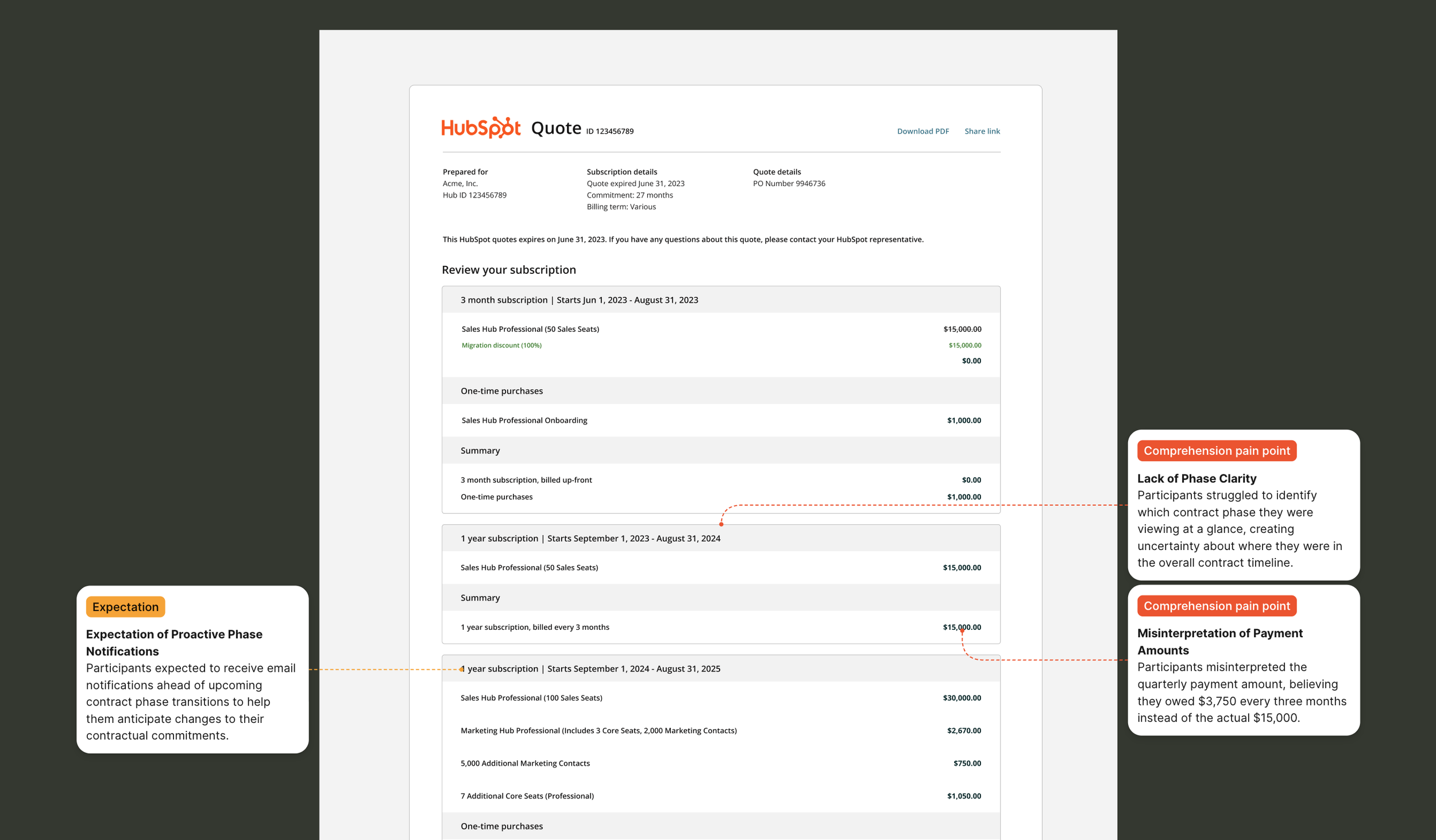
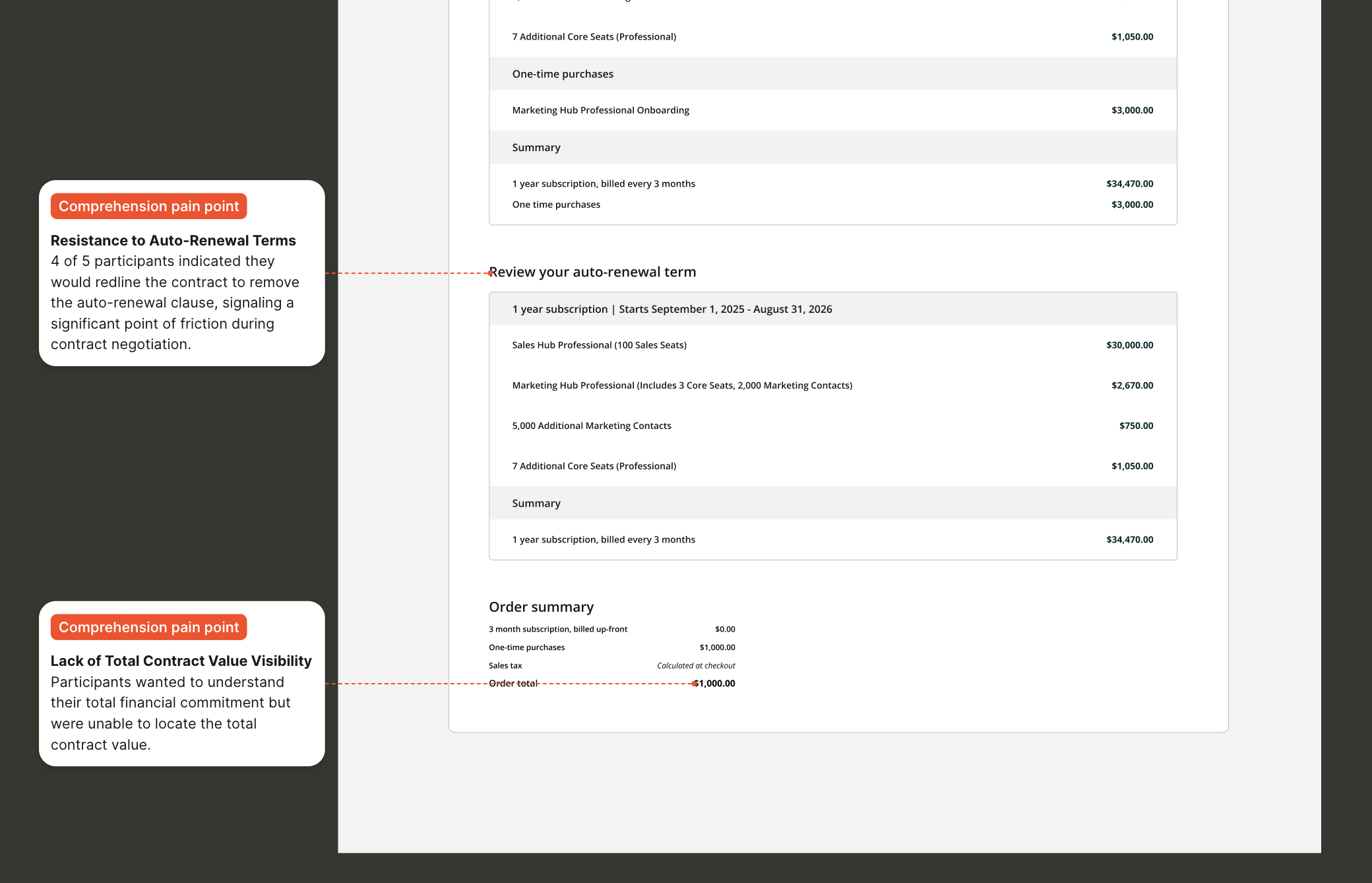
I conducted a baseline comprehension study with five procurement professionals from enterprise organizations (5,000+ employees), each experienced in reviewing complex software contracts.
Participants reviewed a multi-phase contract featuring an introductory period, scaling commitments, onboarding fees, and quarterly billing.
The goal: Identify where existing Quote components caused confusion before investing in a more customized experience.
Next steps:
Turning research into design decisions
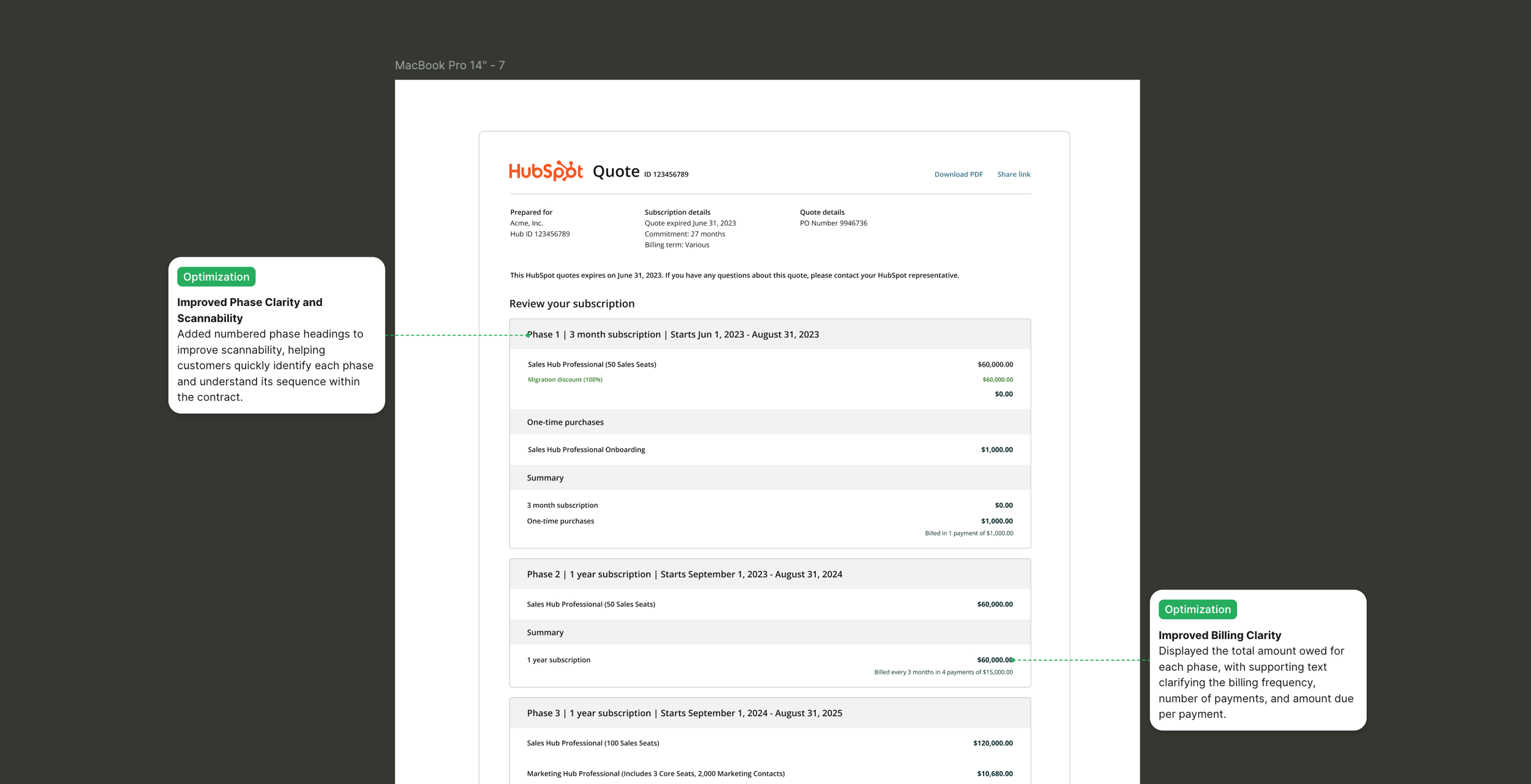
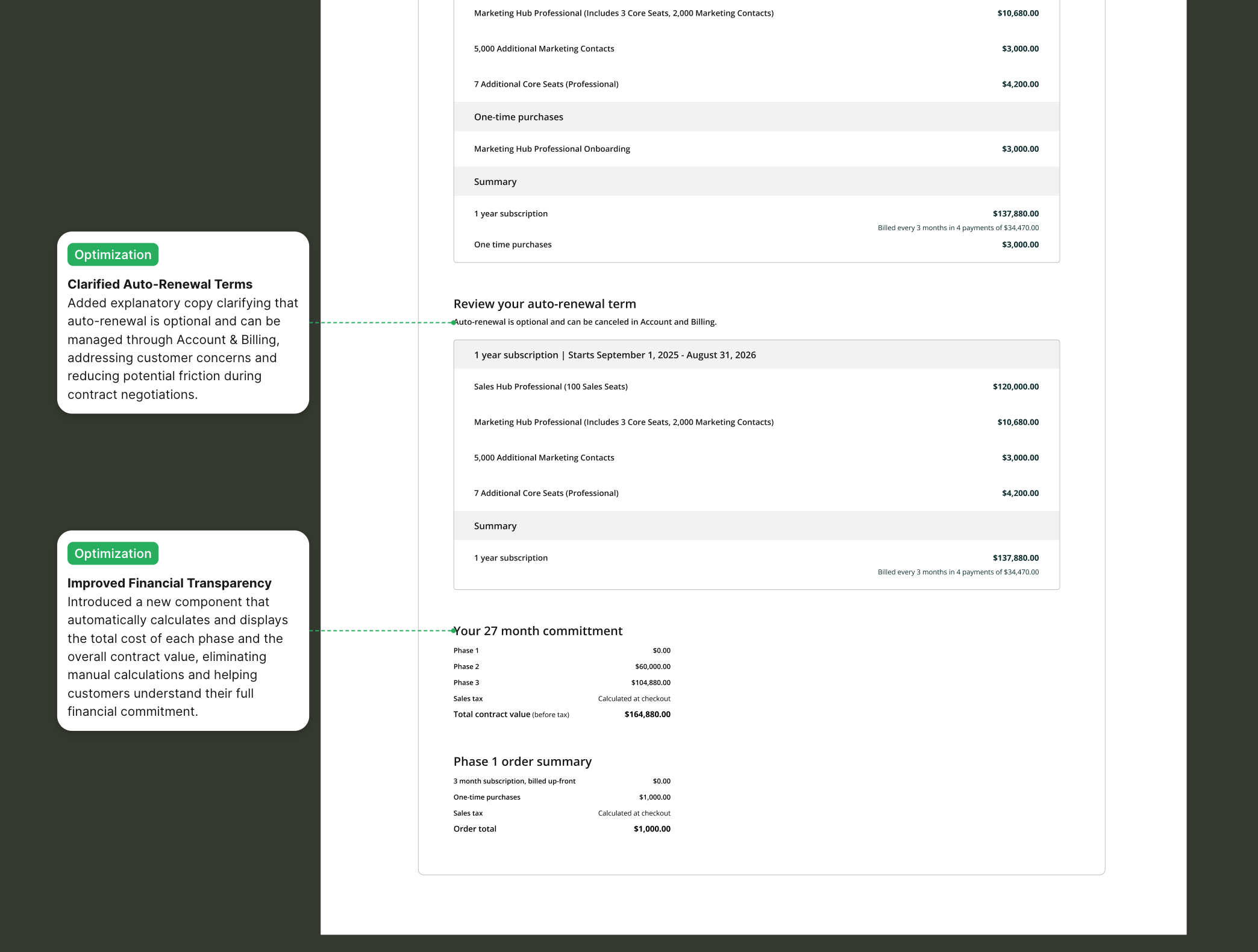
I used these findings to refine the Quote's information hierarchy, clarify financial commitments, and make contract phases easier to understand.
The research also revealed a tradeoff around auto-renewal. Although participants expressed concerns, historical data showed that only 1.9% of HubSpot contracts were sold without it.
Removing auto-renewal by default also introduced the risk of unintentional subscription expiration and data loss.
Decision: We maintained auto-renewal as the default, preserved the option for sales reps to remove it through approval, and clarified that customers could disable it through Account & Billing.
Validating the revised quote
I reviewed the revised Quote with internal stakeholders experienced in reviewing and approving contracts.
HubSpot's procurement lead described the revised experience as "very clear," while corporate sales leaders and contract managers reported improved clarity around billing.
The validated Quote became a shared design reference for how phases and financial commitments would be represented throughout the contracting ecosystem.
“This is incredible”
“This contract is very clear.”
“I really like the billing comprehension, its much clearer for customers.”
Aligning teams around a shared direction
Following the research and iteration, I presented our findings and proposed experience at a cross-functional kickoff with Product, Engineering, Finance, Revenue Recognition, and Deal Desk.
This established a shared understanding of the customer experience, key design decisions, and requirements each team needed to support.
03 — Scaling design across the buying and billing ecosystem
The validated customer-facing Quote established a consistent approach to representing contract phases, financial commitments, billing schedules, and renewal terms.
I translated these decisions into shared UX requirements for participating product teams, each with a designated designer responsible for adapting their experience.
In parallel, designers across approvals, checkout, billing, and renewals adapted their respective experiences to support phased contracts.
I facilitated a biweekly design pod to share progress, review changes, communicate decisions, and resolve cross-product dependencies.
Each team validated its own experience, while my team helped coordinate end-to-end testing to ensure contract information remained consistent throughout the buying and billing journey.
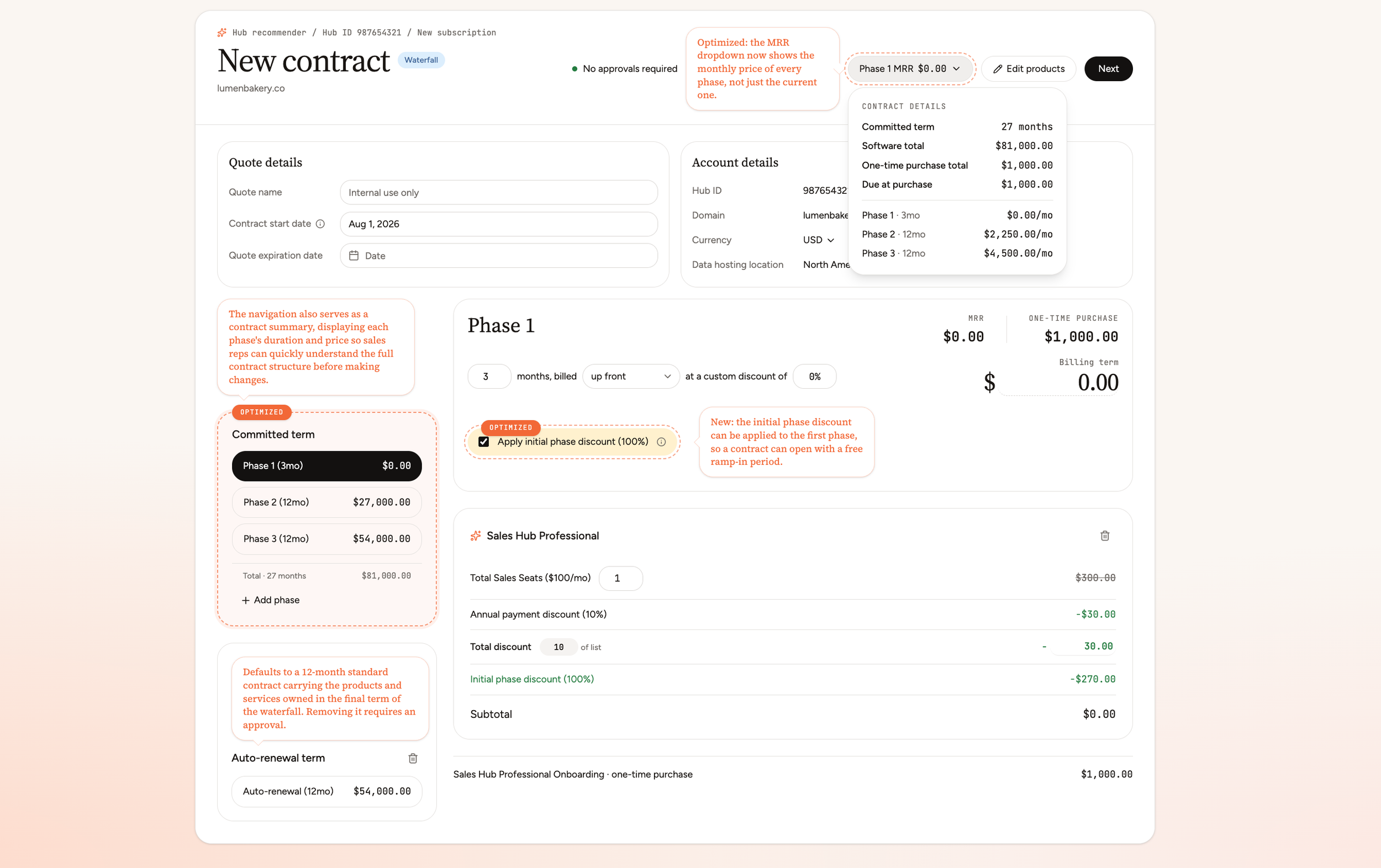
I personally owned the Quote Config experiences for sales teams.
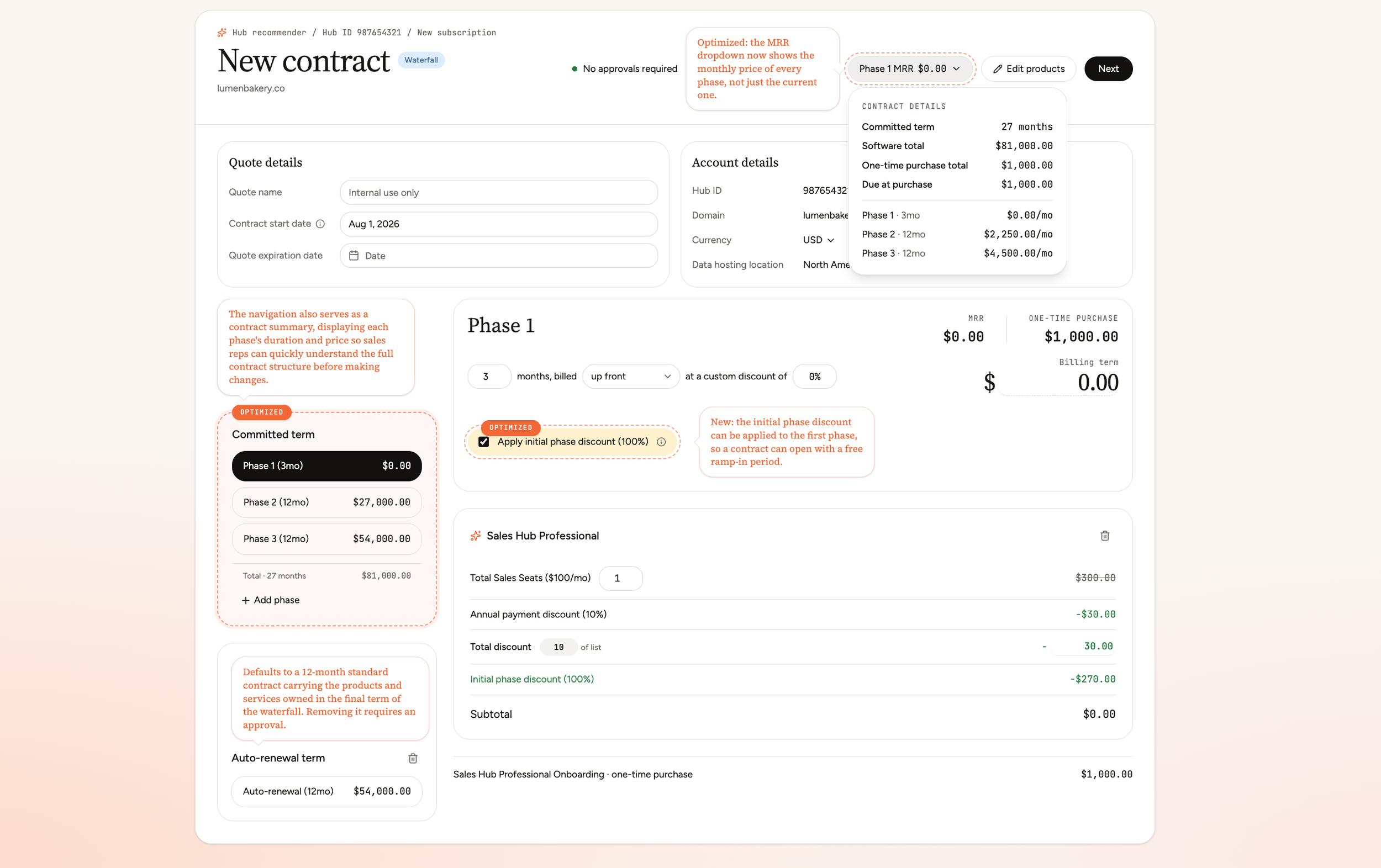
The biggest challenge in Quote Config was enabling sales reps to configure multiple contract phases efficiently without losing sight of the overall agreement.
Reps needed to manage changing quantities, discounts, and commitments across phases while understanding how the contract evolved over time.
My design focused on two priorities:
Efficient configuration: Helping reps build and manage multiple phases without unnecessary repetitive work.
Contract visibility: Providing a summarized view of phases and commitments as reps configured the agreement.
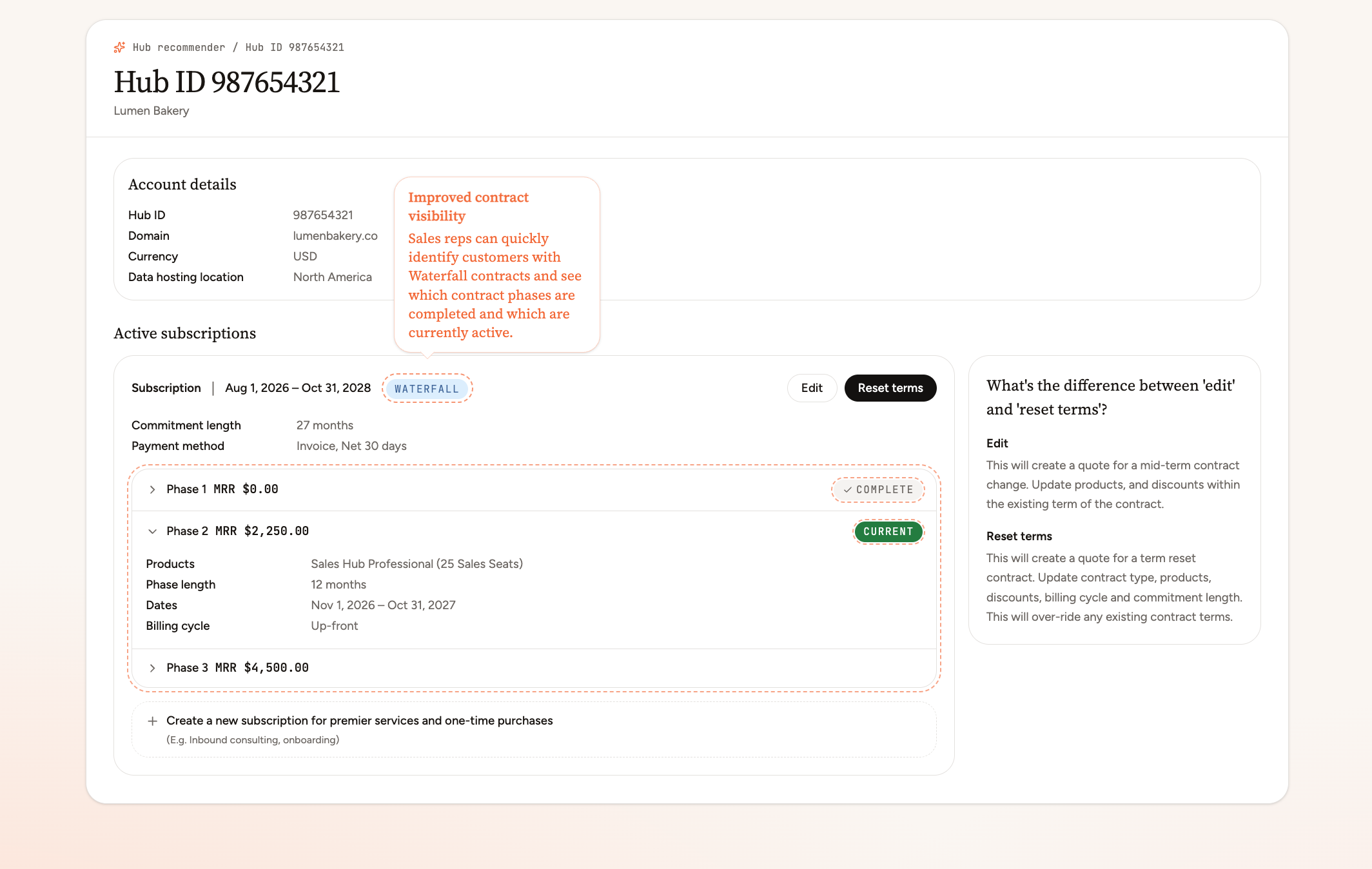
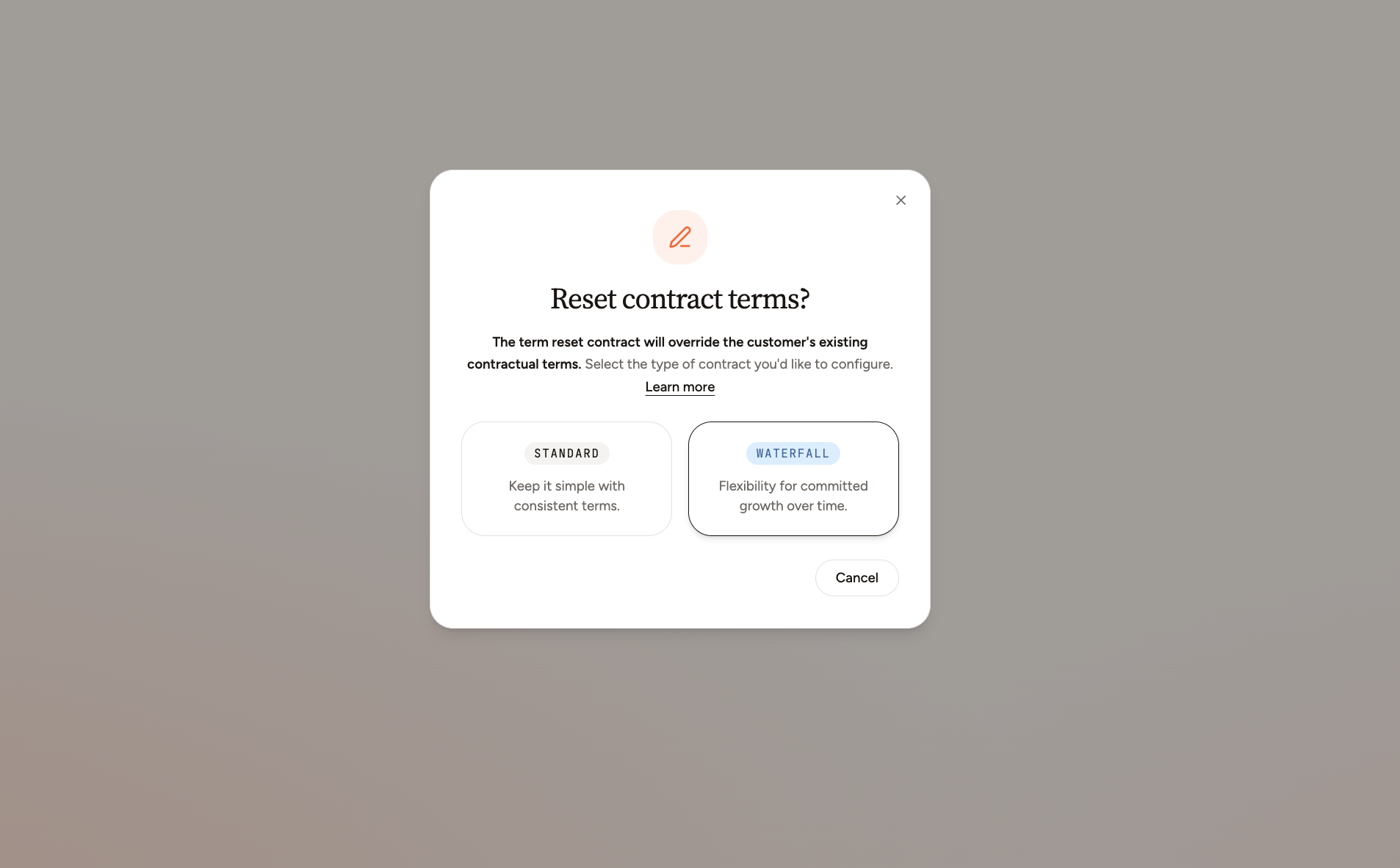
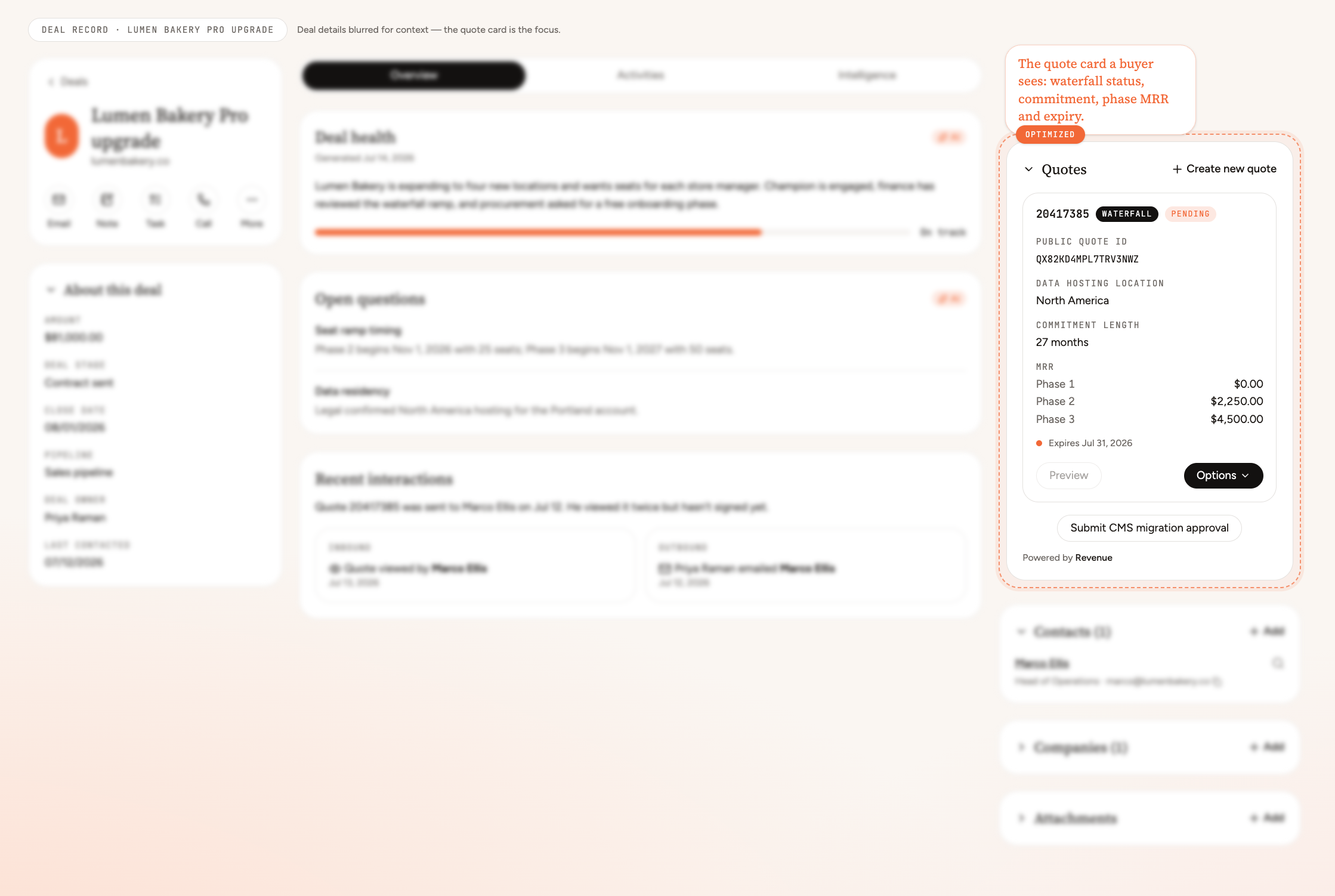
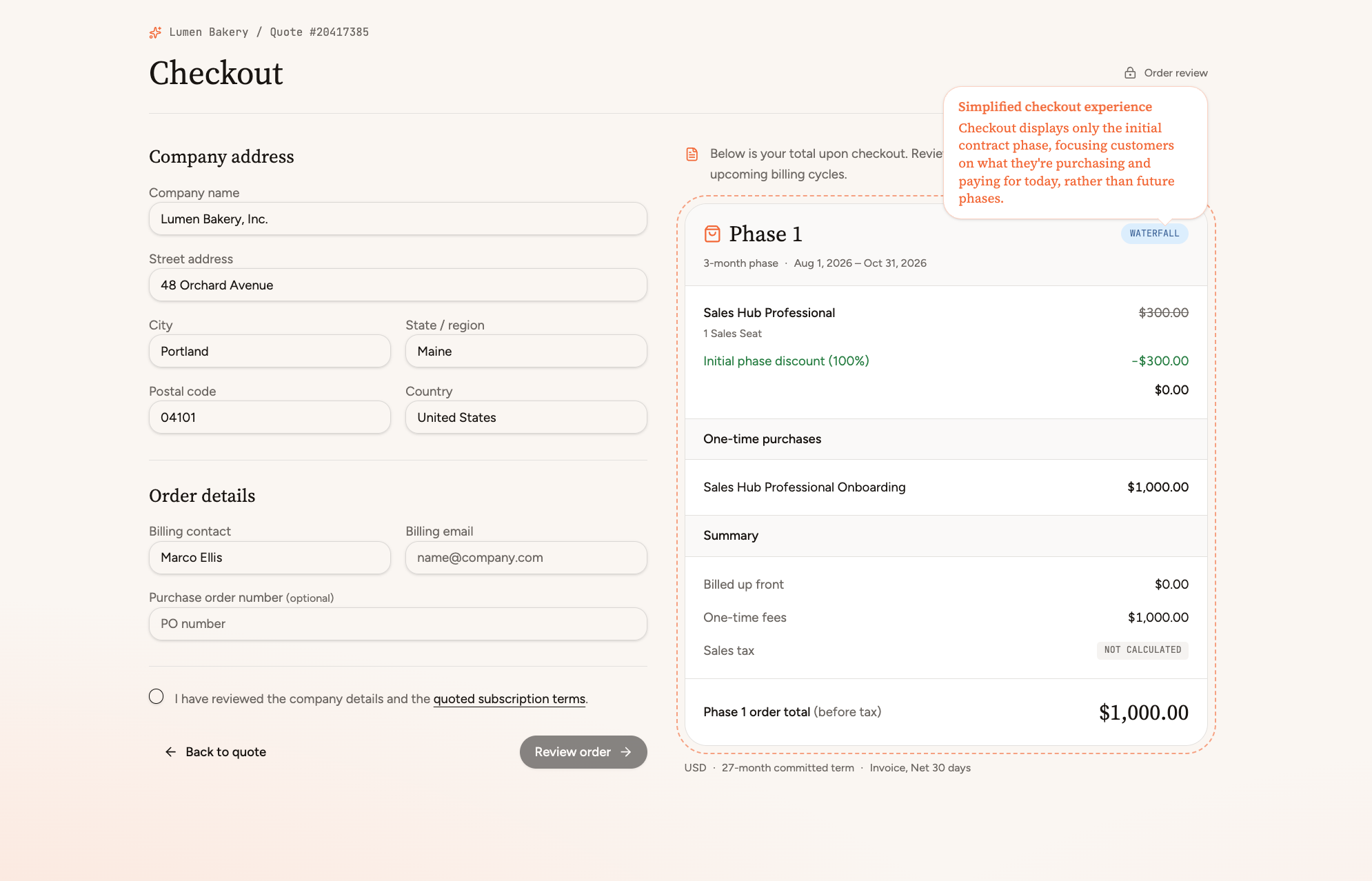
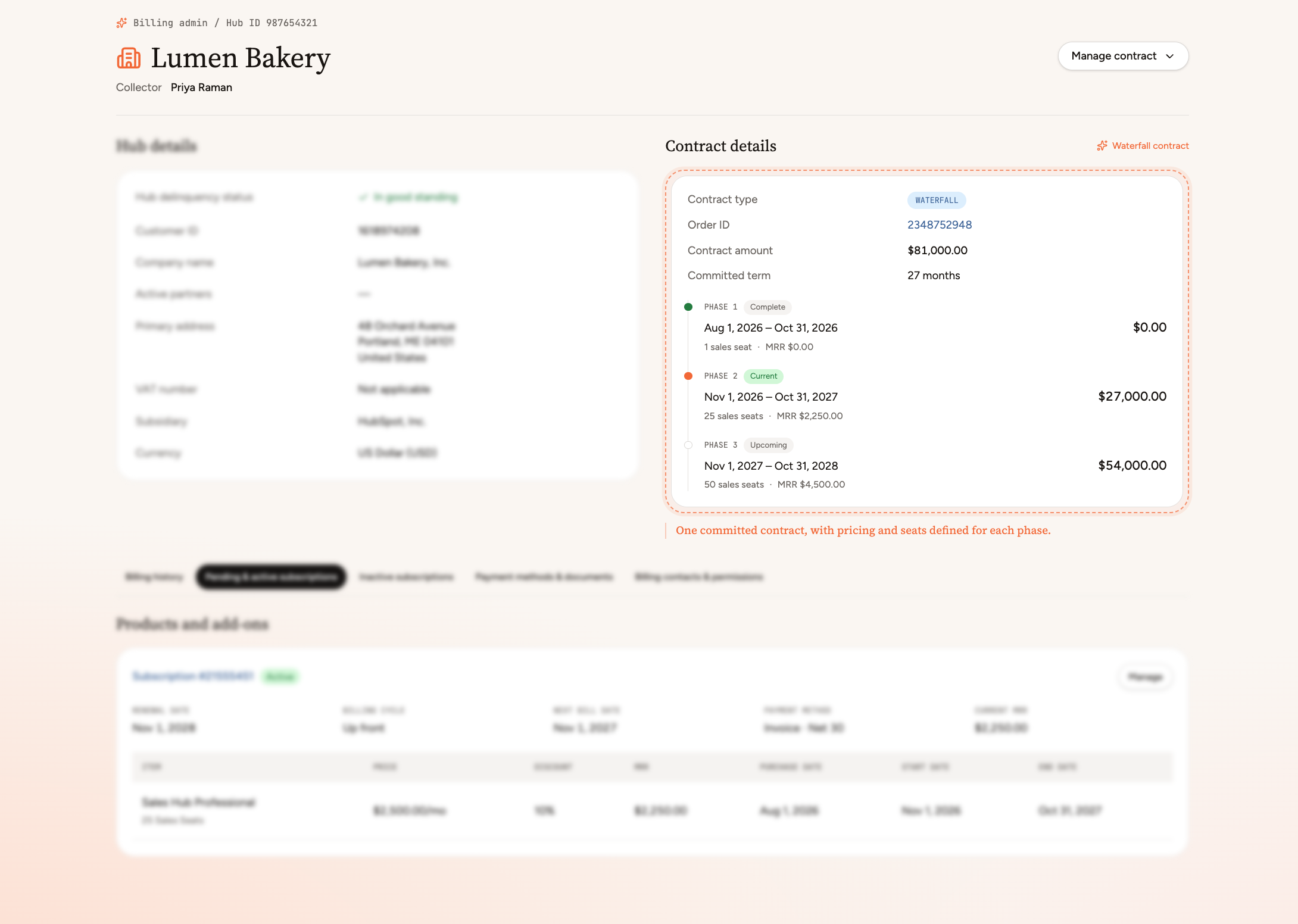
Below, you can see annotated optimizations made across quoting, checkout, and internal billing admin systems.
04 — Supporting milestone 2
Following the initial pilot launch, we continued evolving Waterfall Contracts to support more sophisticated purchasing, contract modifications, and renewals.
I extended the existing Quote and Quote Config experiences to accommodate these scenarios.
01 — Scaling Products & Services
Enabling customers to add products in future phases
The initial experience supported changes to quantities and discounts over time. We expanded this to allow customers to introduce entirely new products and services in later phases.
02 — Mid-Term Contract Changes
Distinguishing completed, current, and future commitments
Modifying an existing phased contract introduced new complexity. Customers could request changes after earlier phases had already been completed.
We needed to distinguish historical commitments from the current phase and future phases that could still be modified.
I updated both Quote Config and the customer-facing Quote to communicate phase status and contract progression.
03 — Phased Renewals
Carrying forward existing commitments into a new contract term
We extended the experience to support customers renewing into another phased agreement.
To maintain continuity, the first phase of the renewal defaulted to the product and pricing terms of the previous contract's final phase.
This introduced additional requirements for how phases were initialized and represented during renewal configuration.
04 — Phase Change Notifications
Giving billing administrators advance notice of upcoming commitments
During initial research, all five procurement participants expressed the need for proactive notifications before entering a new contract phase.
Although deferred from the pilot, we subsequently introduced notifications to alert billing administrators when their next phase was approaching.
This addressed an early research finding and helped customers stay informed as their contractual commitments evolved.
Together, these enhancements extended Waterfall Contracts beyond the initial purchase, supporting product expansion, mid-term modifications, renewals, and proactive billing communication throughout the contract lifecycle.
05 — Impact
From Limited Pilot to Global Release
Waterfall Contracts launched in April 2024 with an initial pilot targeting six net-new contracts. Due to dependencies on automated revenue recognition, the rollout remained controlled while financial infrastructure was developed.
In June 2026, Waterfall Contracts became globally available.
63 contracts executed
$30.6M total contract value sold
$11.8M calculated ARR
Measuring success
01 — Product Capabilities
Introduced the ability to create and execute multi-phase contracts with scheduled changes to products, quantities, pricing, and billing—capabilities previously unsupported by HubSpot's contracting system.
02 — Business Impact
Supported $30.6M in total contract value, with 14 new contracts representing $2.2M ARR in September 2026 alone. HubSpot recognized this as a successful, revenue generating initiative.
03 — Operational Efficiency
Enabled phased commitments within a single contract, reducing the need for separate agreements, repetitive approvals, and manual processes.
Recognition
In recognition of my contributions to Waterfall Contracts, I became one of the first UX designers invited to HubSpot's President's Club, acknowledging the project's business impact and the role design played in delivering it.